For many migrant women in the Helsinki Metropolitan Region, belonging does not emerge primarily through workplaces or official programs. Instead, it is shaped through everyday life in public spaces where they feel safe and recognized. In Finland, one such space stands out: the public library. Through everyday encounters in libraries, women build friendships, learn languages, raise their children, and gradually find their place in the city.
Teksti
Eurídice Hernández Gomes
Integration beyond employment and language
When migration is discussed in public debate, the conversation often turns quickly to “integration.” In policy terms, this usually refers to learning the local language, entering the labour market, and becoming economically self-sufficient. Yet they capture only part of what it means to build a life in a new country.
Integration is also a spatial process. It unfolds through everyday interactions in the places where people spend time, form relationships, and gradually learn how to navigate their new surroundings. For those starting over in an unfamiliar city, belonging is not achieved through a fixed journey or a set of predefined milestones, but through repeated encounters with people and environments that feel accessible, safe, and welcoming. Public spaces therefore become central to the experience of settling into a new society, and among these spaces, public libraries play a particularly important role.
Integration also unfolds through everyday interactions: forming relationships, developing routines, and gradually building a sense of home. Rather than a linear path, with a clear endpoint, it is an ongoing process of negotiation: finding where one belongs, who to connect with, and how to navigate unfamiliar environments.
This perspective invites city-makers to reflect on how urban policy can make us reconsider what we understand by integration. If integration depends on everyday participation in public life, then the design and availability of public spaces become central to the process. Through this lens, libraries are more than cultural institutions, they are urban social infrastructures of belonging, places where integration becomes visible in everyday life.
Navigating a New Language and Culture
The feeling I got from the language café sessions was comfort, knowing that we are all in the same boat […] the inability to communicate effectively in the local language makes it even more challenging to navigate cultural differences.. (Ana, 47, Portuguese).
Ana’s words capture something essential about libraries in Helsinki: they are not only places to access services and learn, but spaces where migrant women recognize themselves in others.
Libraries in Finland are often described as “citizens’ living rooms”. Most residents live within a short distance of one, and they are free, open, and accessible to everyone. Unlike cafés or commercial spaces, libraries do not require you to buy anything. As carefully designed public spaces, they offer a rare combination of accessibility, openness, and safety, while providing access to resources and information.
For the migrant women I spoke to, however, what makes libraries special is not only what they provide, it is what they make possible. Many arrive through marriage or family reunification without jobs or social networks. While their partners spend long hours outside home, working, they must learn how to navigate a new city, understand unfamiliar social norms, and figure out how to create a place for themselves in this new city. In those early months after arriving, the library often becomes one of the few places where they can do it, at their own pace.
Changing Needs, Flexible Spaces
I no longer use the library with the same aims as when I first arrived. Back then, I needed the library to integrate because I had few friends. Now, I have a whole network of people; I study and work, so there’s less time for everything. (Vanda, 46, Brazilian, 2022)
Over time, the role of the library in women’s lives changes. What begins as a place to learn language and navigate daily routines gradually becomes a space for building networks, pursuing personal projects, and participating more actively in the city. Library spaces are notably flexible and adaptable to different needs. They support both structured activities, such as learning new skills, and informal uses, such as meeting others or simply spending time in a welcoming public environment.
This flexibility allows libraries to support women throughout their settlement process in Helsinki. As their lives change, shaped by family responsibilities, personal goals, or time spent in the country, their relationship with the library changes as well. Rather than serving a single function, library uses evolve over time, enabling new social networks and connections to form.
Reflecting its role as a “multicultural living room,” libraries are places where women cultivate social interactions that extend beyond interactions with co-nationals or the local Finnish population. Not only shared language and culture, but also hobbies, and common interests all contribute to multiple and evolving social ties that can provide migrant women with practical and emotional support to achieve not only their professional aspirations but also their personal goals.
Through access to library facilities, that include from co-working spaces and maker labs to instruments and cultural venues, libraries create conditions that support women’s creativity. While some engage in individual projects and use the facilities to brainstorm new project ideas, others use existing relationships within migrant communities as a starting point to connect people to Finnish institutions, services, and the broader public, which in some cases develop into larger community projects. These patterns highlight the importance of flexible, multi-use public spaces that can support different activities throughout the day and across different stages of settlement.
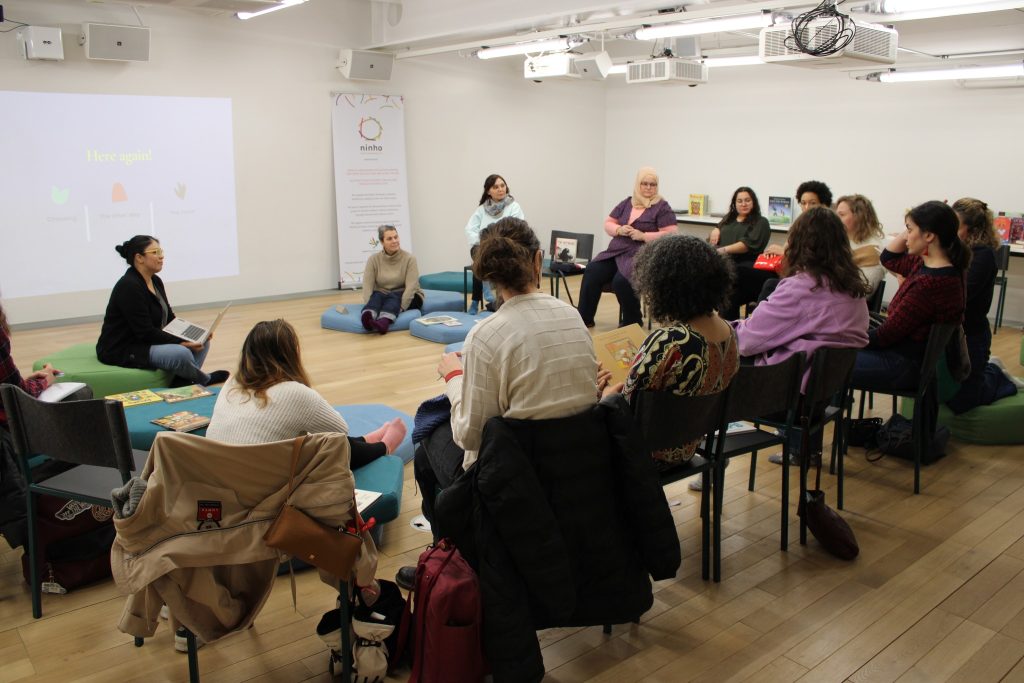
Photograph courtesy of Marta Bermúdez and Ninho ry.
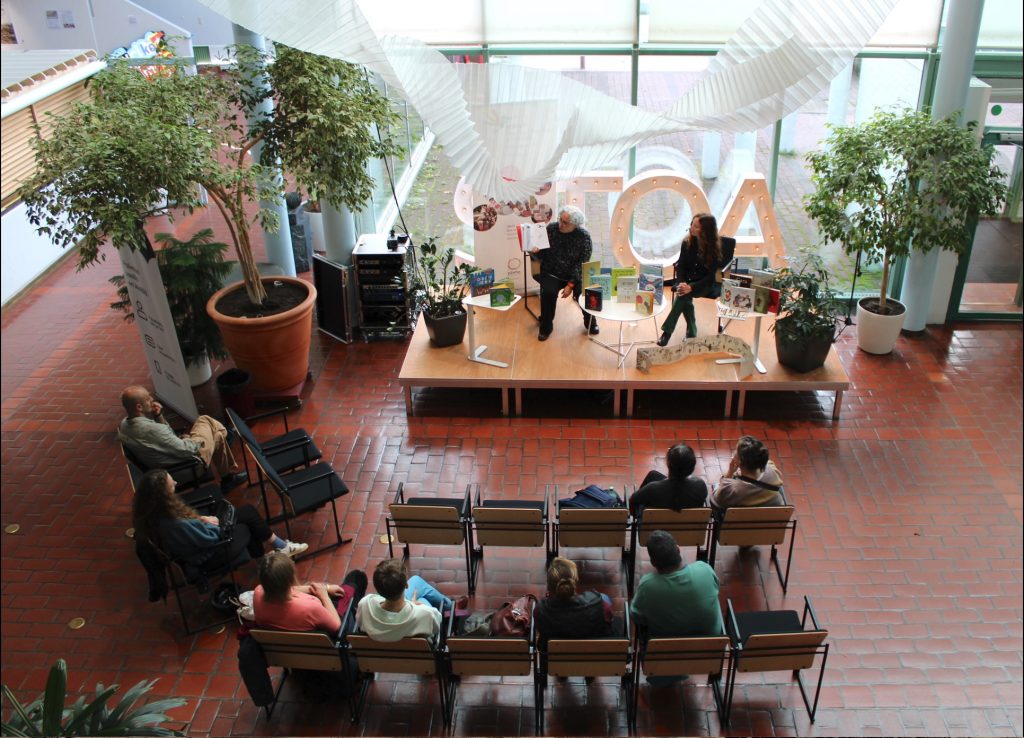
Photograph courtesy of Marta Bermúdez and Ninho ry.
Building Communities in super-diverse container spaces
Libraries promote multiculturalism, helping to support equality and counter racism. That is why I feel welcome there. In the library, I have never felt discriminated against (Sonia, 33, Brazilian).
In Helsinki, libraries bring diverse residents into shared public environment, allowing people to meet, learn, and participate in community life. Libraries are places where the idea of super-diversity becomes visible in everyday life. They are public spaces where people with different migration histories, languages, family situations, and life experiences come together, functioning as container spaces of super-diversity where different social groups build relationships through everyday activities.
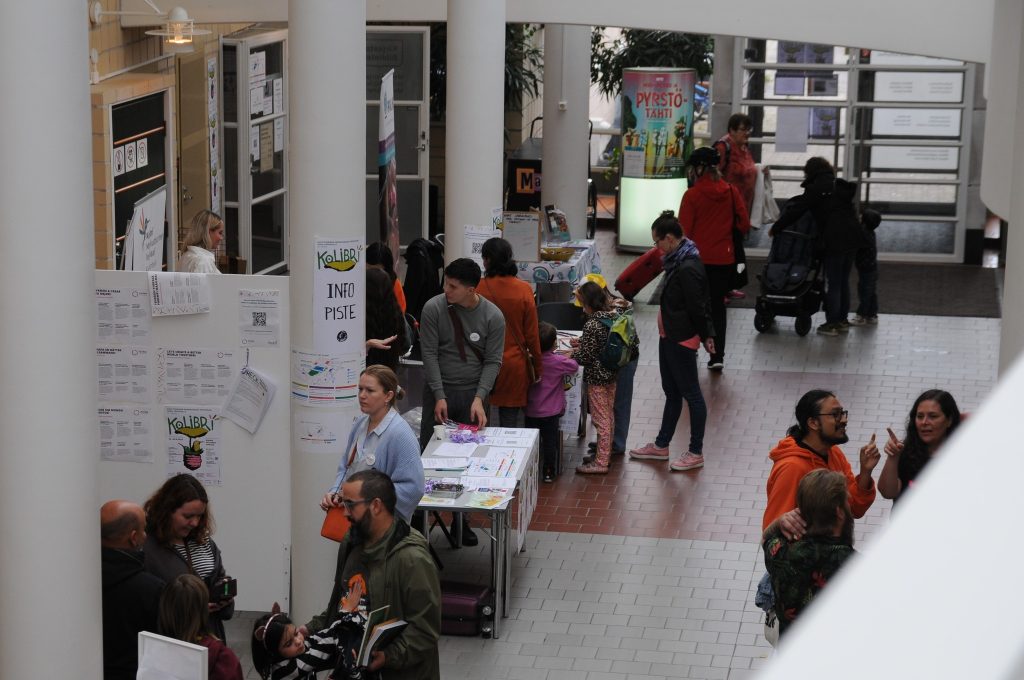
From activities organized by the library, such as language cafés and workshops, to community-led initiatives such as reading nests for migrant families and cultural festivals, libraries act as social hubs within the local community that provide a safe and welcoming atmosphere in which to interact with different people. Over time, these interactions often developed into friendships, support networks, and even professional opportunities that were not limited to one group. Women built relationships with Finnish locals, other migrants, and people from different cultural backgrounds, highlighting the role of libraries as shared public spaces where diverse communities meet, interact, and build connections.
Spaces like libraries that provide experiences of inclusion are especially important because they create a sense of safety that encourages people to spend time in public environments. For many women who have experienced being othered or racialized in other urban settings, super-diverse spaces in the city offer a level of comfort that becomes a precondition for participation in public life. Feeling safe allows them to remain in these spaces, interact with others, and gradually build relationships across different social groups. In this way, libraries demonstrate how inclusive public environments can support everyday encounters with diversity and help residents develop a sense of belonging in the city.
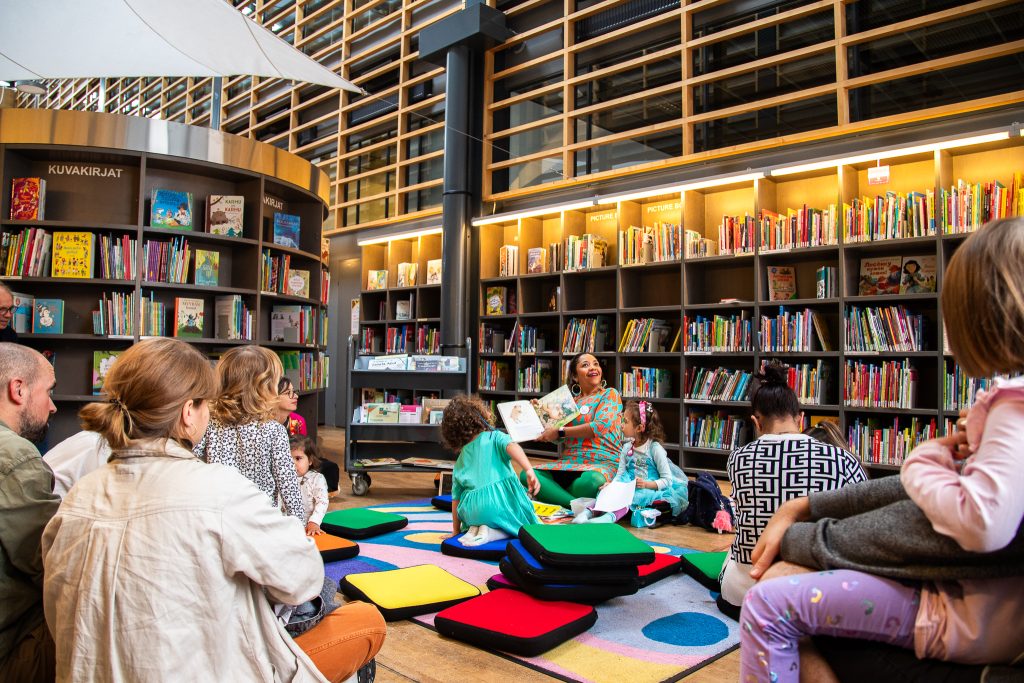
Photograph courtesy of K. Minh Nguyen and Ninho ry.
Libraries as Family Support in Diaspora
In intercultural families, we do not have a support system that helps us. Life is lonely and busy. The library is all I can do; I do not have the time or initiative to go elsewhere. (Alejandra, 36, Nicaraguan)
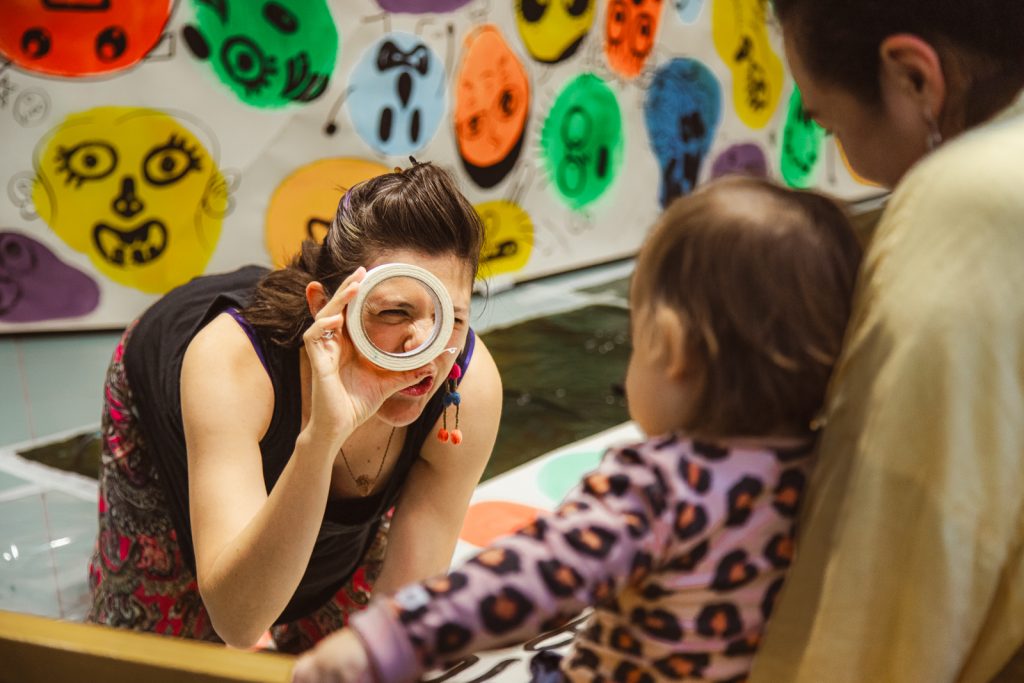
Libraries also play a key role in migrant family life, especially for women who want to keep their heritage language and culture alive in the diaspora. Beyond accessing children’s literature in multiple languages through multilingual library services, many events organized by migrant communities in library spaces are valued as important opportunities to introduce children to others who share the same heritage language and culture.
Photograph courtesy of K. Minh Nguyen and Ninho ry.
Particularly within the Ibero-American community, different generations of mothers have used library spaces to create initiatives for collective reading of children’s literature. One example is the Kolibri Festivaali, a cultural festival that nowadays involves more than 36 languages, but in its origin was created as a place for gathering and symbolic recognition of Ibero-American heritage cultures within Finnish public spaces.
Community activities for migrant and intercultural families organized in libraries also create opportunities for professionals working in early childhood education or foreign language teaching. For these professionals, the library offers a space to promote their work, while for children it provides opportunities to interact with others who speak their heritage language beyond the family environment. These activities also give children access to quality cultural experiences that help them connect with their cultural background while building friendships across cultures. For mothers, meanwhile, libraries offer free activities and opportunities to meet other families with whom they can exchange experiences and information. Over time, these encounters can lead to friendships and informal support networks that help families navigate the challenges of raising children in a new country.
Photograph courtesy of Kamilla Fodor and Ninho ry.
Insights for planning diverse cities
The experiences of migrant women in library spaces reveal something fundamental about how integration actually happens in cities. It is not only shaped through policies, employment, or formal programs, but through everyday encounters in places where people feel safe, recognized, and able to participate in public life. These spatial dimensions of integration show that public spaces should be considered as essential components of integration policies.
In this sense, libraries demonstrate how cities can support belonging through design, accessibility, and openness. Their flexible spaces, welcoming atmosphere, and support for citizen initiatives allow migrants to develop networks, share knowledge, and gradually build confidence in navigating urban life. For many migrant women, the library becomes one of the first places where they can act as city residents rather than newcomers, a space where agency begins to take shape.
Recognizing this role has important implications for planning diverse cities. Integration policies should consider how spatial environments shape social participation. Planning decisions about where libraries are located, how they are designed, and how they are supported institutionally can directly influence migrants’ opportunities to build relationships and access resources. In this sense, libraries should be understood not simply as cultural institutions, but as social infrastructure that enables everyday citizenship.
As cities become increasingly diverse, the question is no longer whether migrants will adapt to urban life, but whether urban environments are designed to support their agency. The future of inclusive cities depends not only on housing, employment, or services, but on the everyday spaces where people meet, interact, and begin to feel that they belong. If integration is about becoming part of the city, then policies must start with the spaces that make belonging possible.
Eurídice Hernández Gomes, M.Soc.Sc. (Urban Studies and Planning)
Department of Cultures, University of Helsinki
Hernández is a Doctoral Researcher in Latin American Studies at the University of Helsinki. Her research focuses on how urban social infrastructure shapes identity formation among cross-cultural children and youth with Latin American backgrounds living in the Helsinki Metropolitan Region. She is also affiliated with FGV Cidades in Brazil and serves on the board of the DIVCULT Standing Committee of IMISCOE.
References:
Hernández Gomes, E., & Kılınç, N., (2026). “The library experience goes far beyond books”: Latin American women’s narratives of transcultural embedding and social integration through using public libraries in Helsinki, Migration Studies, 14(1) https://doi.org/10.1093/migration/mnaf064
Hernandez, E., (2023). “The library experience goes far beyond books”: Spanish and Portuguese-speaking migrant women’s narratives of belonging and use of Helsinki public libraries. Master’s thesis. University of Helsinki. Available at: http://hdl.handle.net/10138/564292
Vertovec, S. (2007). ‘Super-Diversity and Its Implications’, Ethnic and Racial Studies, 30: 1024–54. https:// doi.org/10.1080/01419870701599465